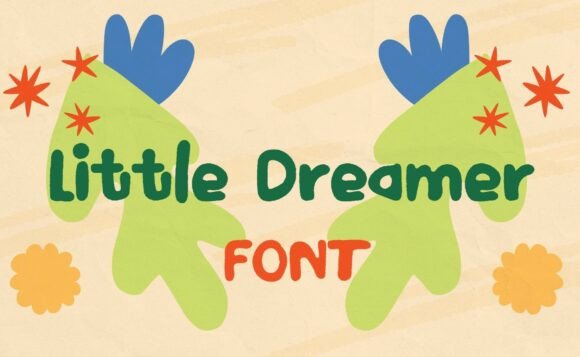
Little Dreamer Font: A Handwritten Typeface That Feels Real
There’s a specific kind of warmth that only comes from something made by hand. In a world saturated with crisp, geometric sans serif fonts and perfectly engineered serifs, a handwritten typeface can cut through the digital noise. Little Dreamer Font is designed to do exactly that. It’s not just a collection of letters; it’s a digital echo of real pen strokes on paper, capturing the fluid, slightly imperfect rhythm of natural handwriting. For designers and creators, it offers an immediate shortcut to authenticity.
The Anatomy of Authenticity: Understanding Little Dreamer's Style
What sets Little Dreamer apart from other script fonts is its carefully crafted imperfection. Many handwritten fonts feel stiff or overly stylized, but Little Dreamer flows with a relaxed, confident ease. Each letterform connects with a natural ligature, mimicking the way a pen would glide across a page without lifting. The baseline has a gentle, organic waver, and the letter spacing isn't mechanically uniform. This isn't a flaw; it's the core of its personality. It feels human.
Visually, it strikes a balance between casual and legible. It’s friendly and approachable without sacrificing readability, even at smaller sizes or in longer passages. The strokes have a consistent, medium weight that provides good contrast against backgrounds without feeling heavy. This makes it a surprisingly versatile display font and a charming option for shorter blocks of text where you want to inject personality.
Where Little Dreamer Truly Shines: Practical Applications
The real value of a creative font like Little Dreamer is in its application. It’s a tool for specific jobs, and knowing where to use it is key. Think of it as the font equivalent of a warm, inviting tone of voice in a conversation.
- Branding & Identity: For businesses built on a personal touch—boutiques, artisan food brands, wellness coaches, indie bookshops—Little Dreamer can become a cornerstone of a brand identity. It works beautifully for logos, taglines, and brand messaging, especially when paired with a clean sans serif font for body copy. It says, "We're real people behind this brand."
- Editorial & Publishing: In editorial design, it excels for pull quotes, chapter headings in personal journals or planners, and titles on book covers for memoirs, poetry, or cozy fiction. It adds a layer of intimacy that a standard serif font might lack.
- Digital & Social Media: For web design, use it sparingly for hero text, call-to-action buttons, or testimonial sections to build trust and warmth. On social media graphics, it’s perfect for inspirational quotes, announcement overlays, and creating a cohesive, approachable feed for a personal brand or small business.
- Packaging & Print: In packaging design, Little Dreamer can highlight product names, ingredient lists, or heartfelt messages on labels for candles, jams, or handmade goods. For print projects like wedding invitations, greeting cards, or thank-you notes, it provides that sought-after handmade feel.
Integrating Little Dreamer Into Your Design Workflow
Adopting a new premium font requires a bit of strategy. Here’s how to make the most of Little Dreamer in your projects.
Evaluate the Project Fit. First, ask if the project’s tone aligns with the font’s personality. Is the goal to feel personal, nostalgic, friendly, or artisanal? If the project demands high-tech, corporate, or ultra-modern aesthetics, Little Dreamer is likely not the right tool. It’s a handwritten font for projects where human connection is the priority.
Master the Font Pairing. The most professional way to use a script font is in combination with a neutral counterpart. Little Dreamer pairs exceptionally well with a geometric or humanist sans serif font like Montserrat, Lato, or Open Sans. The sans serif handles body text, navigation, and functional elements, ensuring clarity, while Little Dreamer steps in for headlines, logos, and accents to add character. Avoid pairing it with another ornate or decorative font, which can create visual chaos.
Test for Readability. Always test your chosen size and color contrast. While legible for a handwritten font, it’s still a display style. Use it for short headlines, logos, and key phrases, not for paragraphs of fine print. Check its rendering on both screens and in print proofs. Pay attention to how letters connect, especially in all-caps settings or with certain letter combinations.
Review the Commercial License. Before using it in any client work, product, or commercial venture, confirm the licensing terms. Most commercial fonts come with clear licenses for desktop, web, and app use. Ensure the license covers your intended use case, whether it’s for a logo, a printed product, or a website. This is a non-negotiable step in professional practice.
Ultimately, Little Dreamer isn’t just another design asset to hoard in your font library. It’s a specific voice. Used thoughtfully, it can elevate a project from feeling generic to feeling genuinely crafted. It bridges the gap between the digital and the personal, offering a touch of warmth in every letterform. For the designer, marketer, or creator looking to tell a more human story, it’s a tool worth exploring.